
SYLVIE ARCHAIMBAULT: Lucien Tesnière et le projet d’atlas linguistique des langues slaves : une non-rencontre avec le Cercle linguistique de Prague
En 1927, Lucien Tesnière venait présenter devant le Cercle linguistique de Prague le résultat de ses travaux sur le slovène, dans une conférence intitulée « Duel et géographie linguistique ». Suite à ce premier contact et en préalable au Congrès des Philologues slaves de Prague de 1929, Antoine Meillet chargeait Lucien Tesnière d’élaborer un projet d’atlas linguistique des langues slaves pour une présentation au Congrès. Ce projet donne lieu à une intervention commune de Meillet et Tesnière lors du Congrès, puis à l’adoption, dès le 9 octobre 1929, d’une motion décidant de la création d’une commission provisoire pour l’organisation du travail d’élaboration de l’atlas.
Antoine Meillet est nommé président d’honneur et Lucien Tesnière secrétaire de la commission.
Les Pragois engagés dans le comité provisoire sont Jakobson, Havránek, Važný, ainsi que Troubetskoy. Havránek, pressenti pour représenter la Tchécoslovaquie, répond immédiatement pour accepter d’y participer, puis, au début de 1930, Troubetzkoy accède à la demande qui lui est faite de représenter les linguistes russes. Dès la fin 1929, Tesnière déploie maints efforts, tentant d’impulser la création de commissions locales par pays et de faire adopter un questionnaire commun. Il se dit fortement encouragé, notamment par Jakobson, pour se lancer dans cette aventure.
Toutefois, comme la correspondance de Lucien Tesnière s’en fait l’écho, de nombreux obstacles viendront barrer la route à l’élaboration de l’atlas, obstacles théoriques et méthodologiques (atlas linguistique « interslave », élaboration d’un questionnaire commun) mais aussi politiques, sans compter l’inertie de certains qui ne se sont jamais sentis vraiment engagés. Finalement, en 1934, juste avant le Congrès des slavistes à Varsovie, Tesnière et Meillet décideront de renoncer au projet et jetteront définitivement l’éponge.
Ce qui aurait pu être l’occasion d’une vraie collaboration entre Tesnière et les Pragois n’aura finalement pas lieu.
Sylvie Archaimbault est directrice de recherche honoraire au CNRS. Elle a dirigé le laboratoire d’histoire des théories linguistiques (CNRS/Université Paris Cité et Sorbonne Nouvelle) de 2000 à 2013 et été directrice adjointe du laboratoire Eur’ORBEM [Europe orientale, balkanique et médiane] (CNRS/Sorbonne Université) de 2019 à 2023.
Ses travaux portent principalement sur l’histoire de la grammaire et de la pensée linguistique en Russie et sur l’histoire de la slavistique, notamment française. Elle est l’auteur d’ouvrages et d’articles sur la norme de langue dans l’histoire et la contemporanéité, la politique linguistique en Russie et en URSS, la slavistique.
Elle est à l’origine du programme NUMERISLAV, dont elle a été la responsable scientifique entre 2017 et 2023, programme qui met à disposition sur un portail dédié (numerislav.huma-num.fr) une sélection des archives conservées à l’Institut d’études slaves de Paris.

GALINA BABAK: Transnational Poetics: Čyževs’kyj’s Theory of Poetic Language and the Prague Linguistic Circle
My paper focuses on Dmytro Čyževs’kyj’s lesser-known 1946 essay Проблеми дослідження поетичної мови (Problems of the Study of Poetic Language), situating it within the theoretical framework of the Prague Linguistic Circle. At the core of my analysis is the concept of written language, as developed within the Circle and understood both as a graphic and phonological system, and as a cultural and semiotic phenomenon examined in its multifunctional relationship to oral and literary language. Already in the 1929 Theses, the members of the Circle articulated the duality between the oral and the written manifestations of language, as well as the strong influence of written language on the oral form of literary language. In 1932, the Prague Linguistic Circle published the collective volume Spisovná čeština a jazyková kultura (Standard Czech and Language Culture), in which, notably in Jan Mukařovský’s essay Jazyk spisovný a jazyk básnický (Literary Language and Poetic Language), the interrelation between literary and poetic language was examined.
The ideas formulated there later became a theoretical paradigm for Čyževs’kyj’s own reflections on poetic language. Already in his early works on Hryhorii Skovoroda and Ukrainian Baroque, Čyževs’kyj paid particular attention to the symbolic dimension of written language, identifying antithesis and symbolism as key elements of Skovoroda’s Baroque style. In his 1946 essay, Čyževs’kyj integrates his reflections on poetic language and style with Heinrich Wölfflin’s concept of the “style of an epoch.”
By developing the theory of the wave-like evolution of literary styles, Čyževs’kyj’s Formalistische Dichtung bei den Slaven (1958) interprets poetic language through the notion of actualization of the word – its foregrounding and deviation from the established conventions of writing characteristic of a particular literary epoch. In his later studies on Russian Futurism – particularly in the preface to Anfänge des russischen Futurismus (1963) and in the article On the Poetry of Russian Futurism (Novyi Žurnal, 1963) Čyževs’kyj further develops these ideas. Čyževs’kyj’s work thus reveals a transcultural dialogue between Russian formalism and broader European theoretical developments, illuminating the potential and contribution of Czech Structuralism to the study of poetic language and literary style.
Galina Babak is an assistant professor at the University of Konstanz. She earned her PhD in Slavic Literatures from Charles University in Prague in 2020, with a dissertation titled Reception of Russian Formalism in Ukrainian Culture in the Interwar Period (1921-1939). Between 2020 and 2024, she held several fellowships and research grants, including fellowships at the New Europe College (Bucharest, Romania), the Center for Advanced Study (Sofia, Bulgaria), the Institute for Human Sciences (IWM) in Vienna, and the Free University in Berlin. From 2022 to 2025, she was a postdoctoral researcher at the Masaryk Institute and Archives of the Czech Academy of Sciences. In 2021, she co-authored a monograph with Alexander Dmitriev, The Atlantis of Soviet National Modernism: The Formal Method in Ukraine (1920s-Early 1930s) (Novoe literaturnoe obozrenie, 2021). Galina Babak’s research explores Ukrainian intellectual history, literary theory, and literary production of the 19th and 20th-century within a broader context of Central-East European political and cultural history.

LORENZO CIGANA: Between Prague and Copenhagen: on Graphemes
One would not stray too much from the truth by saying that the quickly developing field of grapholinguistics has been marked, and perhaps even codified by the dispute about its epistemological possibility (Daniels 1991, Herrick 1994a, Daniels 1994, Herrick 1994b, cf. Meletis 2021), resonating Weinreich’s question on structural dialectology (Weinreich 1954). Beyond the empirical problems raised by the voices in play, the debate is rooted in a clash of positions that is certainly not new or recent: some advocating the full independence of writing systems and written languages from verbal ones, others supporting the dependence of writing on orality.
Such a debate may also be said to characterise, although on a minor scale and on a purely theoretical basis, the exchange between Prague and Copenhagen, in the persons of Josef Vachek (1909–1966), Louis Hjelmslev (1899–1965), Hans Jørgen Uldall (1907–1957) and Paul Diderichsen (1905–1964). Uldall (1944) mentions Vachek (1939) as the most recent and interesting work on the topic, while the latter, in his lifelong study of the writing systems, discusses the stance of glossematics on the matter in a dense contribution (1980 [1989]). In contrast, still little is known about Paul Diderichsen’s attempt to found a structural science of writing systems, dubbed graphematics and established on these very premises (Diderichsen 1952 [1966], and notes, largely unpublished).
The talk intends to reconstruct the polyphony of voices and positions in play between Prague and Copenhagen as the framework for the development of graphematics.
Bibliography:
- Daniels, P. (1991), “Is a structural graphemics possible?” LACUS Forum, 21: 413-424.
- Daniels, P. T. (1994), “Reply to Herrick”, Lacus Forum, 21, pp. 425-431.
- Diderichsen. P. (1952) [1966], “Bidrag til en analyse af det danske skriftsprogs struktur”, Helhed og struktur. Udvalgte sprogvidenskabelige afhandlinger, Norlundes Bogtrykkeri, København.
- Herrick, E. M. (1994b), “Reply to Daniels’s Reply”, LACUS Forum, 21: 432-440.
- Herrick. E. M. (1994a), “Of course a structural graphemics is possible!”, LACUS Forum, 21: 413-424.
- Hjelmslev, L. (1961), Prolegomena to a Theory of Language, University of Wisconsin Press, Madison.
- Meletis, D. (2021), “There had already been a structural graphemics. Revisiting and contextualizing a grapholinguistics dispute”, LACUS Forum, 47, 1: 6-17.
- Uldall, H. J. (1944), “Speech and writing”, Acta Linguistica, 4, 1: 11-17.
- Vachek, J. (1939), “Zum Problem der geschriebenen Sprache”, Travaux du Cercle Linguistique de Prague, 8: 94-104, also in [1989]: 103-116.
- Vachek, J. (1980) [1989], “Glossematics and written language”, Written language revisited, John Benjamins, Amsterdam/Philadelphia: 53-60.
- Weinreich, U. (1954), “Is a Structural Dialectology Possible”, Word, 10: 2-3.
Lorenzo Cigana is Associate Professor of Semiotics and Philosophy of Language at the San Raffaele University of Rome (Uniroma5). He has worked on the epistemology of language sciences, with particular attention to the structural paradigm in linguistics and semiotics, and more specifically to the theory of language of Danish linguist Louis Hjelmslev (1899-1965) and his circle. His interests lie in the issues of form and formalisation in language sciences, and particularly in the history of the theory of markedness.

K. K. LEONARD CHAN: A Reading of Jaroslav Průšek’s Sinology and the Prague School Structuralism
Jaroslav Průšek (1906-1980), a renowned Czechoslovak scholar, is widely recognized as a leading figure in European Sinology. He entered Charles University in 1925 to study the histories of ancient Greece, Byzantium, and the Roman Empire. He pursued further studies in Chinese and Japanese language and culture under Bernhard Karlgren at the University of Göteborg in 1928, followed by research on Chinese history with Gustar Haloun and Erich Hänisch in Germany. In 1932 he traveled to China to study its socio-economic history, followed by two years in Japan before returning to Prague in 1937. Upon his return, he taught Chinese, published the first Czech Chinese Colloquial Reader (1938), translated several Chinese canonical works of literature and philosophy. He also began participating in the Prague Linguistic Circle activities and thereby was influenced by the literary theories of Jan Mukařovský (1891-1975).
After World War II, Průšek started teaching at Charles University’s Faculty of Arts. He was later appointed Director of the Oriental Institute at the Czechoslovak Academy of Sciences. Průšek’s major works in sinology such as Chinese History and Literature: Collection of Studies (1970) and The Lyrical and the Epic: Studies of Modern Chinese Literature (1980) have made significant impact in the West as well as in the Chinese-speaking academia.
His literary scholarship uniquely integrates Prague Structuralism with discourses of socialist realism, resulting in an aesthetic vision and critical methodology that are both distinctive and, at times, ambiguous. With a reverent attitude, Průšek approached Chinese “literature of the people,” seeking life’s resonance through lived experience. Under the constraints of political ideology, he developed a methodology for understanding Chinese literature that reflects both insight and blind spots – an ambivalence that warrants deeper reflection. This paper will explore the complex interplay between Průšek’s scholarship (with special reference to the influence of Mukařovský) and his contemporary politics during the Nazi years and the ensuing socialist regime, up until the Prague Spring of 1968.
Such an inquiry allows us to reflect on the entanglement and interaction between literary study and cultural politics in times of historical tension. It shows that the path of literature does not end with historical calamities. Rather, the quiet yet persistent flow of poetic thought in times of rupture brings about the birth and rebirth of literature.
Kwok Kou Leonard CHAN is currently holding positions as a Yushan Scholar Chair Professor at National Tsing Hua University and Fellow of The Hong Kong Academy of the Humanities. His past experience includes positions at The Education University of Hong Kong as Chair Professor of Chinese Literature and the Founding Dean of the Faculty of Humanities.
Leonard Chan’s areas of expertise include Chinese literary criticism, literary historiography, Hong Kong literature, and Chinese-Western comparative literature. His research outputs encompass more than 20 books, including The Reception of Tang Poetry in Ming Neo-Classical Criticism (唐詩的傳承:明代復古詩論研究), and over a hundred of research articles. Leonard Chan’s latest publication Discourses on Chinese Lyrical Tradition and Literary Historiography (抒情傳統論與中國文學史) would best manifest his study of “Chinese Lyrical Tradition” over the years. The book spans through academic scholarships of the Continental Europe, North America and Mainland China, Taiwan and Hong Kong, and exhibits the dynamics and diversity of the relevant discourses in relation to the comparative study of Chinese literature.

STÉPHANIE CIRAC: Al’fred Ljudvigovic Bem et le Cercle linguistique de Prague. Relations autour de « menues observations »
Source de déclassement pour nombre de savants, l’exil peut néanmoins leur offrir une position privilégiée dans le transfert culturel. Certains exilés russes jouèrent un rôle non négligeable dans les échanges scientifiques de la Tchécoslovaquie de l’entre-deux-guerres. Cependant, ce rôle fut souvent peu visible ou inégal. L’histoire a certes retenu l’importance de Roman Jakobson dans la construction du Cercle linguistique de Prague (CLP) – même si sa place dans la généalogie du CLP est diversement interprétée (Glanc, 2018). D’autres exilés, furent moins éminents, tel Al’fred Bem. Quel membre du CLP fut-il ? Quel rôle joua-t-il dans les transferts scientifiques autour du CLP ? Que nous dit sa trajectoire des liens entre le CLP et l’exil ? L’appartenance au CLP est parfois malaisée à retracer (Čermák et alii, p. 357). Dans le cas de Bem, on peut la dater. Il est cependant plus intéressant de la mesurer à l’aune de ses contributions au CLP et de l’écoute dont elles bénéficièrent. Si l’on observe sa fréquentation du CLP, le rythme des séances, le profil de ses auditeurs, ressort la progression d’une appartenance fondée sur des affinités et des échanges. Quant aux thèmes qu’il aborde, comme la notion des « menues observations », pour mieux comprendre les relations qu’il noue autour du CLP, on observera comment la presse s’est fait l’écho des conférences de Bem et la réception de ses idées dans la société tchèque. Des liens s’esquissent avec des passeurs tchèques – Karel Krejčí (České Slovo), Antonín Mágr (Prager Presse) –, des communautés d’idées se dessinent, qui nous permettent de percevoir le rayonnement du CLP dans les années 1930, porté par un savant parmi d’autres. Qu’il fût mineur offre un éclairage original sur l’histoire du CLP et de ses réseaux. Ces relations nous montrent aussi que le CLP fut une terre d’accueil remarquable pour les savants en exil.
Bibliographie :
- Glanc Tomáš, 2018, Une généalogie du structuralisme, Communication, p. 197-211.
- Čermák Petr, 2012, Poeta Claudio & Čermák Jan, Pražský lingvistický kroužek v dokumentech, Praha, Academia.
Stéphanie Cirac a consacré une grande partie de ses recherches à l’émigration savante russe en Europe centrale. Elle a en particulier étudié la présence russe dans la Tchécoslovaquie de l’entre-deux-guerres, dans une moindre mesure en Pologne à travers notamment la figure d’Al’fred Bem. Elle est également éditrice spécialisée sur les cultures et sociétés d’Europe centrale.

Catherine DEPRETTO /discussant/
Catherine Depretto est professeur émérite de littérature russe à Sorbonne université et a été directrice de la Revue des études slaves de 2012 à 2025. Son domaine de spécialité est la théorie littéraire en terrain russe, le formalisme et l’œuvre de Jurij Tynjanov dont elle a traduit les principaux textes critiques en français. Elle a publié en 2009, Le formalisme en Russie (nouvelle version en russe, 2015). Elle a également consacré des recherches à l’histoire culturelle de la période soviétique et aux formes non-fictionnelles du récit de soi. Son ouvrage, Littérature, sciences humaines, pratique diariste. Essais sur la culture de la période soviétique est paru en 2025. Elle est actuellement engagée dans des travaux sur André Mazon et la slavistique de l’entre-deux-guerres.

ALEXANDER DMITRIEV: Ukrainian Connections of the Prague Linguistic Circle
In the literature on the Prague Linguistic Circle, multiculturalism and multilingualism in the complex interwar conditions are quite rightly considered to be very important features of the group (Toman 1995; Pilshchikov 2019; Flack 2024); these relations were not always harmonious, but were sometimes quite conflictual, often implicitly (Ehlers 1996; Glanc 2022). This paper aims to conduct a comprehensive analysis of the circle’s Ukrainian relations, which have been only partially researched (Karunyk 2016; Babak 2022; Karunyk 2023). It is essential to note that Dmytro Čyževs’kyj (1894-1975) had a methodological and philosophical connection with the circle, whereas Čyževs’kyj himself was only indirectly linked to the cultural and literary aspects of the circle’s interests, despite this being his primary research interest. This distancing can be explained by a number of factors related to Čyževs’kyj’s “individualistic” scholar trajectory since the early 1920s (interest in phenomenology and ethics, indifference to the Herbartian tradition) (Vojvodík 2022).
Publications by Vasyl’ Simovyč (1880-1944) or Agenor Artymovyč (1879-1935) in Traveaux were much closer to “craft” linguistic issues, but their structuralist turn was not welcomed by supporters of more traditional methods in Lviv and Galicia (Danilenko 2003). Finally, in the mid-1940s, Simovyč’s direct contacts in Lviv with Ševelov, who had evacuated there from Kharkiv, marked the beginning of a new stage in the reception of the circle’s ideas in Ukrainian linguistics. In the 1930s and early 1940s in Soviet Ukraine (under the leadership of Leonid Bulachovs’kyj) and then in the late 1940s and 1950s with the support of Jakobson, Ševelov was mainly concerned with the historical aspects of the development of both the Ukrainian language and other Slavic languages (Wakoulenko, Karunyk 2017). The acute ideological conflict between Jakobson and Ševelov since the 1960s is particularly vividly reflected in the latter’s extensive memoirs. Now, in the mid-2020s, this dispute can no longer be viewed unilaterally (for example, as a recurrence of the Cold War). Both Čyževs’kyj and Ševelov raised the question (Čyževs’kyj 1976) in their retrospective works about the peculiarities of the legacy of the Prague Linguistic Circle, including in connection with the republication of Simovyč’s works (through the efforts of Ševelov). In contrast to Jakobson’s free contacts with Soviet linguists after 1953, both Čyževs’kyj and Ševelov remained persona non grata in Soviet Ukraine after Stalin’s death. In part, these “external” factors also meant that while Soviet and, for example, Estonian “permitted” structuralism existed, there was essentially no Ukrainian version of it within the USSR.
Alexander Dmitriev is assistant professor at Charles University (Prague), author and editor of books: The Atlantis of Soviet National Modernism: The Formal Method in Ukraine (1920s-Early 1930s) (together with Galina Babak) (2021), Human Sciences: History of Disciplines (2015), Marxism Without the Proletariat: Georg Lukács and the Early Frankfurt School (2004), and a number of others. His areas of interest include the evolution of formalism, the history of universities, and the history of science.

PATRICK FLACK: The Prague Linguistic Circle and the Netherlands
This paper reconstructs the underexplored vectors linking the Prague Linguistic Circle to Dutch linguistics and literary theory from the interwar years through the postwar internationalization of structuralism. It first repositions Hendrik J. Pos as a philosophical mediator: after a phenomenological and anthropological turn, Pos provided a justificatory horizon for the new phonology emerging from Prague, sharpening Dutch debates on function, system, and norm. Second, the paper re-maps the Dutch scholarly network that intersected with Prague: Jac. van Ginneken (pioneering psycholinguistics, open to functional-phonological method), Nicolaas van Wijk (Slavist, connector to Prague and mentor to van Schooneveld), and Anton Reichling (with A. W. de Groot), whose debates with Bühler on the Organonmodel register a specifically Dutch recalibration of Central European structuralism. Third, it examines channels that shaped the Anglo-American reception of Jakobson via Dutch interlocutors. Central here is C. H. van Schooneveld, whose editorial work transformed Prague structuralism into a portable canon for North American scholarship. Finally, the triangular relationship between Prague, the Netherlands, and Copenhagen is highlighted. The Dutch milieu served as a hinge: van Ginneken maintained contacts with Louis Hjelmslev, who in turn engaged with Pos. By combining archival traces with a historiographical lens, the paper shows how Dutch figures and institutions functioned as strategic mediators, linking Prague’s classical period both to Scandinavian structuralism and to the transatlantic reception of Jakobson.
Patrick Flack is Senior Lecturer in the History of Ideas in Central and Eastern Europe at the University of Fribourg since 2021. After studying Russian, philosophy, and history in Geneva, Berlin, and Moscow, he obtained a PhD from Charles University in Prague (2011). He subsequently worked as an SNSF postdoctoral researcher at the Central European Institute of Philosophy (Prague), the Peter Szondi Institute (Berlin), and the Husserl Archives (Leuven). In 2012, he founded the publishing house sdvig press, which specializes in open-access digital academic publishing and manages the international project Open Commons of Phenomenology.

TOMÁŠ GLANC: Prague School: suppressed Practice, Policy, Politics
The Prague Linguistic Circle stands as the most influential and internationally successful intellectual project in twentieth-century humanities scholarship to emerge from Czechoslovakia. What is particularly fascinating is the way its story has been told for over a hundred years. The heterogeneous network of scholars associated with the Circle not only generated a set of remarkable concepts and key terms whose relevance extended well beyond their immediate historical moment; they also appear to have anticipated the future coherence of their work, as if they had programmed in advance how individual articles, interventions, and theses would later be assembled into a synthetic narrative. This contribution reflects on several facts and interpretative possibilities that, on the one hand, address the question of how this canon came into being and, on the other hand, point to what remains outside its imaginary boundaries. Rather than reaffirming the established narrative, it asks what had to be excluded, muted, or forgotten for the Prague School to become what it is now taken to be.
Tomáš Glanc’s research focuses on East European culture and cultural theory, samizdat and other forms of unofficial media and cultural practice, performance in Eastern Europe, Slavic ideologies, and contemporary discourses in Slavic studies. He has authored and edited several books, as well as a large number of scholarly articles and other academic contributions. He has also served as an expert contributor to numerous radio and television programmes and podcasts. He has (co-)organised international conferences and curated exhibitions, including Poetry & Performance: The Eastern European Perspective (co-curated with Sabine Hänsgen), which was realisedten times across Europe. He has served as Director of the Institute of Slavic and East European Studies at Charles University in Prague, Director of the Czech Cultural Center in Moscow, Senior Fellow at the University of Bremen, Visiting Professor at Humboldt University of Berlin, and Visiting Professor at the University of Basel. Since 2014, he has been affiliated with the University of Zurich.

ISABEL JACOBS: Living Form: Morphology and the Formation of the Prague School
This paper explores the formation and legacy of the Prague School through the prism of biological, evolutionary, ecological, morphological and vegetal discourses. It argues that the Circle’s so-called (proto-)structuralism was deeply entangled with theories of the organism, living form and plant life that were indebted to the morphological tradition, from Goethe and Haeckel to Emanuel Rádl. Reconstructing the impact of Czech and Russian biology on the Prague school, and reframing it in light of recent debates on the “vegetal turn”, I explore how the reception of Darwin and German biological Naturphilosophie informed theories of linguistic structure and development. More concretely, I will read Tynjanov and Jakobson’s theory of linguistic evolution as a response to both Saussure and Darwin, exploring themes of descent, deformity and difference. There will also be a short detour into organic and plant metaphors in Iliazd’s 1922 futurist talk on “pearl disease” which I read in the light of both Jakobson and vegetal paradigms of the time. Finally, the paper wraps up with an analysis of Ernst Cassirer’s engagement with the Prague circle through his late article “Structuralism in Modern Linguistics”, written after his encounter with Jakobson during their shared passage into exile in the US.
Isabel Jacobs is a writer, editor, and translator. She is currently a Postdoctoral Fellow at the Institute of Philosophy, Czech Academy of Sciences, where she works on the reception of Goethe and Haeckel’s morphology across the sciences and humanities in socialist Eastern Europe. In 2026, she is a Visiting Fellow at the Institute of Contemporary History in Ljubljana. She holds a PhD in Comparative Literature from Queen Mary University of London and an MA in Russian and East European Literature and Culture from University College London. Her work explores the intersection of philosophy, visual culture, and the history of science. She has published and lectured widely, with a focus on German, Russian, and French philosophy. Her co-edited volume Authority, History, and Political Theology is forthcoming with Bloomsbury. She is currently writing a book on Alexandre Kojève and aesthetics.

JOHN E. JOSEPH: The Enlightening and Dark Webs of Relations Spun by Mathesius’s Devotion to Deutschbein
It is entirely appropriate that we mark the centenary of the Prague Linguistic Circle by seeking out their less well-known intellectual relations. Opening long-closed closets is however bound to turn up the occasional skeleton. Little attention has gone to what the work of Vilém Mathesius (1882–1946), one of the Circle’s founders, owed to the Marburg philologist Max Deutschbein (1876-1949). The debt is expressed in a number of Mathesius’s works. Deutschbein’s original outlook on the syntax of the English sentence had a profound impact on Mathesius’s formulation of what would become ‘functional sentence perspective’. Deutschbein’s approach was shaped by the idealism of Croce and Vossler, and his deeper aim was to comprehend the English Rassenseele (racial soul) through the syntax of English texts from Chaucer onward, together with modern spoken English. His work draws on a wide range of studies, including those by Alexander Bain (1818-1903), who besides his philological pursuits was the leading figure in British psychology of the second half of the 19th century and whose ‘associationism’, I have argued, lies behind Saussure’s ‘associative’ (later renamed ‘paradigmatic’) axis. But speaking of Axis… like many German academics of the 1930s, Deutschbein signed the declaration of support for Adolf Hitler by professors at German universities and colleges in November 1933, was a member of the National Socialist Teachers’ League and became a member of the Nazi Party in 1937. This obviously casts a shadow over his philological delving into the “racial soul”. Many joined the party not out of political commitment but fear of the consequences of not joining, and I do not know what Deutschbein’s motives were. Nor am I suggesting guilt by association, but rather that it is in the interest of preserving the Prague Linguistic Circle’s heritage that we confront this uncomfortable relation in Mathesius’s work.
John E. Joseph is Professor of Applied Linguistics in the University of Edinburgh. His PhD thesis on language standardisation (which became the basis of his book Eloquence and Power: The Rise of Language Standards and Standard Languages, Blackwell, 1988) engaged deeply with Prague School work on literary language. His work in the history of linguistics includes Limiting the Arbitrary: Linguistic Naturalism and Its Opposites in Plato’s Cratylus and Modern Theories of Language (Benjamins, 2000), From Whitney to Chomsky: Essays in the History of American Linguistics (Benjamins, 2002), Saussure (Oxford UP, 2012)and Language, Mind and Body: A Conceptual History (Cambridge UP, 2018). He has recently edited The Bloomsbury Handbook of Saussure (Bloomsbury, 2025).

KATERYNA KARUNYK: The Chronology of ‘Dynamic Synchrony’ as a Theoretical Notion: George Y. Ševelov under Roman Jakobson’s and Nikolaj Trubeckoj’s Impact
Pursuing the structural methodology since the early 1940s, the Ukrainian linguist George Y. Ševelov (1908–2002), after settling in 1952 in the US, published a number of books and papers on the history of the Slavic languages in which he was deliberately applying this approach: The Problems in the Formation of Belorussian (1953), A Prehistory of Slavic. A historical Phonology of the Common Slavic (1964), Teasers and Appeasers (1971), A Historical Phonology of the Ukrainian Language (1979), In and Around Kiev (1994) a. o. Yet he was not fully satisfied either with Jan Baudouin de Courtenay’s or with Ferdinand de Saussure’s treatment especially of the notion of synchrony. Instead of a disjunction of synchrony and diachrony, quite erroneous in his view, Ševelov would rather let them be in unison, inasmuch as all language phenomena find their explanation within both these dimensions.
Being a partisan of the Prague linguistic circle, he regarded language system as never stable and constantly striving for its internal balance. Thus Ševelov, building upon Roman Jakobson’s and Nikolaj Trubeckoj’s theoretical views, put forward such notions as ‘balancing system’ and ‘dynamic synchrony’. The key element in all his studies (be it phonology or syntax) is the insight into tendencies which helped him understand which way a language system is inclined to evolve. The paper will follow the chronology of the use of the term dynamic synchrony in Ševelov’s linguistic œuvre from the early 1950s on, comparing his theoretical stance with that of Jakobson and Trubeckoj.
Kateryna Karunyk, PhD is associate professor at the department of the Ukrainian Studies at Kharkiv National University (Ukraine). She studied Ukrainian and English languages and literature in Skovoroda National Pedagogic University in Kharkiv (2004–2009). In 2019 she was awarded PhD degree for the thesis George Y. Ševelov’s research into the Ukrainian language. She joined the research projects “Region, Nation and Beyond. An Interdisciplinary and Transcultural Reconceptualization of Ukraine” (2012–2014), “Corpus Planning, Unplanning and Replanning for Ukrainian” (2015–2016), “Transnational Contact Zones: Redefining Ukrainian Regionalism” (2016–2018). A member (since 2012) and Head of the Linguistic group (since 2019) in the Kharkiv Historico-Philological Society. Points of research interest: history of linguistics, Soviet language policy, history of the Ukrainian and Slavic language, George Y. Ševelov.

EVA KRÁSOVÁ /organising committee/
Eva Krásová teaches theory of literature at the Institute of Czech Literature and Comparative Studies at the Faculty of Arts, Charles University in Prague.
Her research focuses on the linguistic historiography of the 20th century based ontextual genetics and archive materials. nd French linguists mainly Emile Benveniste, Antoine Meillet, Jan Mukařovský, Vilém Mathesius, Vladimír Skalička, etc.
In addition, she has long been a lecturer in world literature in creative writing programmes, first at the Josef Škvorecký Literary Academy, and from 2015 to the present at the Text and Screenplay Department of the Jaroslav Ježek Conservatory and College, where she has had the opportunity to meet young poets in their formative stages.
Her most recent professional interest is the analysis of popular culture using the tools of classical narratology and pop culture tropology and the resulting reflections on the place of literature in the contemporary media situation.

PETR MAREŠ: The Prague School and Concepts of Style and Stylistics in the First Half of the Twentieth Century
The contribution will analyse how the Prague School’s views on style and stylistics have developed through dialogue and confrontation with earlier and contemporary European theories. The analysis is based on comments contained in the writings of various members of the Prague School that critically examine the approaches of diverse stylistic schools and individual scholars. Overall, the concepts discussed served as impulses for the authors to formulate their own opinions.
In particular, the following issues deserve attention:
(1) The so-called idealistic stylistics as an important trend of the period (Leo Spitzer and others): While Jan Mukařovský echoed Spitzer’s approach in his early study of Božena Němcová’s style, and Otokar Fischer was clearly inspired by the assumption that a writer’s psychology determines his style, the linguistic wing of the Prague School found it difficult to accept Spitzer’s focus on the author’s individual creativity and on the aesthetic uniqueness of literary works. For instance, Josef Miloslav Kořínek argued that stylistics conceived in this way lies outside the scope of linguistics because it is limited to the sphere of parole. In contrast, linguistic stylistics must deal with established, standardised modes of verbal expression.
(2) Charles Bally’s stylistics: It was seen as a needed deliverance of stylistics from fixation on literature, but the idea of linking style to emotionality was considered too limited and unsuitable.
(3) Positive and welcoming evaluation of approaches to style that were based on choice of options, norms of expression and functions of texts in communication (Jules Marouzeau, Kazimierz Budzyk and others).
(4) The assumption that languages as a whole are characterized by distinct styles (Fritz Strohmeyer). This concept may seem rather marginal, but especially Vilém Mathesius devoted considerable attention to it.
Prof. PhDr. Petr Mareš, CSc., is affiliated with the Institute of Czech Language and Theory of Communication, Faculty of Arts, Charles University, Prague, where he was promoted to full professor in 2004. His research interests include style, the structure of texts and communication and relationships between verbal and non-verbal communication. He is author of four monographs and, inter alia, co-author of the handbook Stylistika mluvené a psané češtiny (The Stylistics of Spoken and Written Czech, 2016).

MARTINA MECCO: Olaf Broch: A Norwegian Slavist at the Prague School
From the second half of the nineteenth century, and more intensively during the interwar period, the relationships between the Czech context and the Scandinavian countries were pivotal for the construction of an international cultural and scholarly discourse. In recent years, relevant case studies have been published, such as those concerning Louis Hjemslev’s relations with Sergej Karcevskij and Roman Jakobson (Cigana 2022), or Arnošt Kraus’ activities as cultural transfer with Scandinavia (Lainto 2021). The Norwegian context still appears peripheral in the interest of scholars focused on the history of European linguistics.
Olaf Broch (1867-1961) must be considered the founder of Norwegian Slavic Studies. He became a member of the Prague School in December 1938, shortly before the outbreak of the Second World War. However, his relationship with the Czech context predates the First World War. At the beginning of the twentieth century, he spent some time in the Russian Empire, where he became acquainted with Filipp Fortunatov, Aleksej Šachmatov (Lönngren 2015) and his student Petr Savickij (Karelin – Repnevskij 2018), later a prominent figure of the Eurasianist movement and a member of the Prague School. His path led him to Central Europe, where he was in contact with prominent figures such as the Slavist Vratislav Jagić and the linguist František Pastrnek. His collaboration with the Archiv für slavische Literatur and the publication of his monograph, Studien von der slovakisch-kleinrussischen Sprachgrenze im östlichen Ungarn (1879), which received considerable attention in the Czechophone periodicals of the time, represent key steps in his establishment as a scholar. Among his visits to Prague, the one in 1905 was particularly significant for one of the founders of the Prague School, Vilém Mathesius. In his memoirs, Mathesius recalls: “A great scientific experience for me, toward the end of my university studies, was the meeting with the Norwegian slavist Olaf Broch” (Mathesius 2009: 16). Broch’s influence on the members of the Prague School can also be traced in the case of Roman Jakobson. In On Czech Verse (1923; 1926), Broch’s name appears in the references alongside other representatives of late-nineteenth-century versology, such as the French Paul Verrier and the German Franz Saran. Moreover, Broch remained an important figure in Jakobson’s scholarly development in the United States, as attested by their frequent correspondence.
In this paper, I aim to reconstruct the influence of Olaf Broch on the members of the Prague School, considering him as a prominent example of a scholar who moved within a quadrangular framework (Norway – Russia – Czechoslovakia – France). Broch emerges as a key figure due to his ability to cultivate relationships with different generations of linguists and philologists. In this presentation, I will draw upon published materials (newspapers and journals) as well as archival sources from LA PNP, MIT and the National Library of Norway (Nasjonalbiblioteket) in Oslo (Bjørnflaten 2012).
Martina Mecco earned her PhD in Germanic and Slavic Studies at Sapienza University of Rome and Charles University in Prague. In her doctoral dissertation, she analysed Roman Jakobson’s activity in Czech periodicals published during the interwar period, focusing on his role as a cultural transfer between the Russian and Czech contexts. Within the MODERNITAS research team (ULB MSH), she collaborates on the FNRS-PDR project Belgium “Read” in German and Czech. Her research interests include the history of literary theory (Russian Formalism, Czech Structuralism), cultural transfer studies and history of Slavic studies. She is currently working on a forthcoming monograph titled Archaeology of Slavic Studies: Roman Jakobson and Slavische Rundschau (1929-1939) and coediting an anthology of Russian Formalism in Italian. She translates poetry from Czech, Slovak, and Russian.

MICHAŁ MRUGALSKI: Transferring the Theory of Poetic Language: A Polish Connection
In 1937, a group of young Polish literary theorists, inspired by the Prague Linguistic Circle and particularly by Roman Jakobson, published a festschrift for Kazimierz Wóycicki – the Polish precursor of structuralist literary studies. Three Prague Linguistic Circle members contributed to this collective volume: Roman Jakobson, Nikolaj Trubeckoj, and Josef Hrabák, a lesser-known specialist in Polish studies within the Circle. Their contributions, supplemented by an essay from Jerzy Kuryłowicz, the Polish pioneer of structural linguistics, formed a section devoted to the linguistic structure of poetic utterances.
Each author approached the problem of poetic language from a distinct angle: Jakobson analyzed Greek prosody, Trubeckoj examined the versology of Russian bylinas, Kuryłowicz addressed Old German metrics, and Hrabák explored Polish medieval eight-syllable verse. My paper situates these studies in dialogue with one another and with the programmatic theses on poetic language formulated by the Prague Linguistic Circle, to show how localized case studies reflect and reciprocally refine the general theory – revealing the translinguistic dynamics at the heart of structuralist poetics.
Michał Mrugalski is privatdozent at the Department of Slavic and Hungarian Studies at the Humboldt University of Berlin. After receiving his PhD in Literary Studies from the University of Warsaw, he habilitated at the University of Tübingen with a venia legendi in Comparative and General Literary Studies as well as Slavic Literature and Culture; he has taught and researched at the Universities of Warsaw, Tübingen, Berlin (Humboldt-Universität), Basel, Sibiu, and Brussels (Université libre). His research interests include interrelations between literature and the visual arts, theater, performance, and film; transcultural intellectual history of aesthetics; literary theory and comparative literature (with a focus on Russia, Poland, the Czech Republic, German and English-speaking countries, and France); computational literary studies; and narratology.

AYA ONO: Le Cercle linguistique de Prague et les linguistes japonais : réseaux scientifiques transnationaux et transferts théoriques (1927-1939)
Les relations entre le Cercle linguistique de Prague et le milieu linguistique japonais constituent un chapitre méconnu de l’histoire du structuralisme. Cette communication vise à éclairer ces connexions transnationales en s’appuyant sur des sources d’archives et des témoignages documentés.
En 1927, un groupe de linguistes et d’orientalistes se forme à Osaka autour de Juntaro Ishihama et de Nikolai Nevsky, ce dernier formé par Baudouin de Courtenay et Ščerba. Ce réseau marque le début d’une circulation d’idées entre la tradition linguistique russe et le contexte japonais. Dès 1930, Nikolai Trubetzkoy manifeste son intérêt pour la langue japonaise, notamment pour la question de l’accent musical, comme en témoigne sa correspondance avec Roman Jakobson. Evgeny Polivanov semble avoir joué un rôle de médiateur dans ces échanges, possiblement par l’intermédiaire de son disciple O. Pletner présent au Japon.
Le tournant décisif se produit au Deuxième Congrès international des linguistes à Genève en 1931, où de nombreux membres du Cercle de Prague présentent leurs travaux. Plusieurs linguistes japonais y assistent, notamment Chiba Tsutomu, Ichikawa Sanki, Saito Shizuka et Takamatsu Yoshio, prenant ainsi connaissance des développements en phonologie structurale. Ces rencontres favorisent la diffusion des concepts pragois au Japon et l’établissement de réseaux savants durables.
En analysant ces différents moments et acteurs, nous montrerons comment s’est constitué un transfert théorique entre Prague et le Japon, mettant en lumière le rôle des figures intermédiaires russes et l’importance des congrès internationaux dans la circulation des idées linguistiques. Cette étude contribue à élargir notre compréhension de l’École de Prague comme centre d’échanges intellectuels véritablement mondiaux
Aya Ono is Professor at the Department of Foreign Languages and Liberal Arts, Faculty of Science and Technology, Keio University, Japan. She holds a PhD in Language Sciences from the Université Paris X-Nanterre. Her research focuses on the history of linguistic thought, with particular emphasis on the work of Émile Benveniste and the reception of Saussurism in Japan. Her publications include “La réception japonaise de « De la subjectivité dans le langage » d’Émile Benveniste” in Émile Benveniste, 50 ans après Les Problèmes de linguistique générale (Éditions Rue d’Ulm, 2019), “Prépositions, verbes pronominaux et voix moyenne : Un nouveau point de vue sur la subjectivité langagière d’Émile Benveniste” (Blityri, 2019), and “« Le nom c’est l’être » : Les notes préparatoires d’Émile Benveniste à l’article « La blasphémie et l’euphémie »” (Genesis, 2012).

IGOR PILSHCHIKOV: Jakobson’s Three Theories of Puškin’s Poetics and Their Geocultural Localizations (Moscow – Prague – Warsaw)
Alongside Chlebnikov and Majakovskij, Puškin served as a testing ground for Jakobson’s theoretical endeavors. The paper examines three cycles of Roman Jakobson’s studies of Puškin’s works and the corresponding three theories of Puškin’s poetics, which Jakobson never unified into a single framework. These theories align with three stages of his scholarly evolution, each localized in a distinct geo-cultural and intellectual context. The first – the theory of poetic dialectology and the motivation of poetic devices – belongs to his Moscow Formalist period. The second – the theory of poetic mythology and authorial invariants – is associated with his Prague Structuralist phase. The third – the grammar of poetry and the poetry of grammar – is usually linked to his American semiotic period; however, at least in the field of Puškin studies, it was closely connected with Jakobson’s collaboration with Polish semioticians. Jakobson’s programmatic statements for each theory were delivered, respectively, at the Moscow Linguistic Circle in 1919, the Prague Linguistic Circle in 1937, and the Warsaw Congress on Poetics in 1960. The paper draws on both Jakobson’s published works and archival materials from Russian, Czech, and American collections.
Igor Pilshchikov is Professor (and 2022-25 Chair) of the Department of Slavic, East European and Eurasian Languages & Cultures at the University of California, Los Angeles (UCLA), NETSIM Project Leader (Lucian Blaga University in Sibiu, Romania), and Visiting Professor at Tallinn University (Estonia). He is the founding academic editor of the Fundamental Digital Library of Russian Literature & Folklore [http://feb-web.ru] and CPCL: Information System on Comparative Poetics and Comparative Literature [https://en.cpcl.info], and editor of Studia Metrica et Poetica [https://ojs.utlib.ee/index.php/smp] (University of Tartu Press) and Pushkin Review [https://muse.jhu.edu/journal/532] (Slavica Publishers). He has authored two monographs on the Russian “Golden Age” poets (Batiuškov and Puškin) and a book of interviews on philology and digital humanities. In addition, he has edited thirty collections of essays, conference proceedings, and thematic journal issues, and published extensively across several areas, including Russian poetry in comparative perspective, the Russian reception of Romance literatures, Russian and East/Central European literary theory, cultural semiotics, poetics, verse theory, and corpora building.

ILONA SINZELLE POŇAVIČOVÁ: Entre traduction, analyse en temps de crise et transfert : contributions féminines méconnues du Cercle linguistique de Prague
Si l’École de Prague fut, dès ses origines, un espace international de circulation des idées, ce réseau savant compta un certain nombre d’auditrices — plusieurs dizaines au total — dont la présence reste en grande partie invisible. Cependant, seules trois des femmes ayant des liens avec le Cercle linguistique de Prague avant la fin de 1939 se distinguent par une activité intellectuelle directe identifiable au sein du Cercle : Noémi Schlochow, Ingeborg Seidel-Slotty et Giulia Porru.
Noémi Schlochow (1896-1983), originaire de Colmar, professeur du français à l’Institut Ernest Denis à Prague, joua un rôle discret mais capital dans la médiation entre le Cercle linguistique de Prague et public international. Sans statut officiel de membre ni conférence personnelle, elle traduisit plusieurs textes des premiers Travaux du Cercle linguistique de Prague, contribuant à leur diffusion internationale ; il est même probable qu’elle participa à la traduction des Thèses de 1929.
La linguiste allemande Ingeborg Seidel-Slotty (1910-1973), exilée à Prague en 1933 pour fuir le nazisme, développa dans ses travaux les questions de finalité et de fonctions du langage. Sans présenter de conférence au sein du Cercle, elle fut néanmoins la première femme à publier dans Slovo a slovesnost (1936), où elle analysa l’influence du national-socialisme sur l’allemand, en se basant sur le recueil d’exemples d’usage de la langue dans le « Troisième Reich » qu’elle a compilé avec son mari Eugen Seidel, également linguiste.
Enfin, Giulia Porru Mazzuoli (1913-2000 ?), linguiste formée à Florence auprès de Giacomo Devoto, contribua à introduire la phonologie structurale praguoise dans le contexte italien. Après sa communication au sein du Cercle linguistique de Prague sur la phonologie de l’italien et sa publication aux Travaux et malgré le fait qu’elle ne fut pas autrement présente physiquement, elle devint, selon les listes internes, première membre officiel de Cercle linguistique de Prague féminin.
Ces trois trajectoires féminines – traductrice-passeuse, exilée-analyste, importatrice adaptatrice – révèlent une partie méconnue du réseau intellectuel de l’École de Prague, où le transfert culturel s’incarne aussi en figures féminines encore insuffisamment étudiées.
Ilona Sinzelle Poňavičová is a member of the research units Histoire des Théories Linguistiques (HTL – UMR 7597) and Centre de recherches Europes-Eurasie (CREE – EA 4513). Her research focuses on Czech philological and linguistic traditions, language standardisation and glottopolitics from the perspective of the Prague Linguistic Circle, as well as Czech quasi-diglossia. In November 2025, she defended a dissertation entitled The Prague Linguistic Circle and the Czech Language: A Genealogy of a Theory of the Literary-Standard Language (supervised by Christian Puech and Catherine Servant). She previously taught Czech language, culture and civilisation at INALCO, and also contributed to MA level teaching on linguistic norm and variation.

PATRICK SÉRIOT: Transferts culturels ou obstacle épistémologique : une terminologie linguistique importée en Tchécoslovaquie par les émigrés russe / Cultural Transfers or Epistemological Obstacles: Linguistic Terminology Imported into Czechoslovakia by Russian Emigrants
(FR) La collaboration intellectuelle internationale en sciences humaines est moins simple qu’en sciences naturelles, parce que le poids des « traditions scientifiques » peut difficilement s’effacer. Lorsque les émigrés russes apparaissent à Prague au début des années 1920, leur intégration scientifique ne se fait pas sans heurts, malgré l’accueil favorable qui leur est réservé au niveau officiel.
Je propose d’étudier dans cette intervention un certain nombre de termes-clés dont la traduction en langues « occidentales » a donné lieu à des malentendus, voire à des contresens, d’autant plus graves qu’ils sont parfois restés invisibles, ou non détectés.
Ainsi en va-t-il des notions comme structure, système, totalité, Ganzheit, celostnost’, celek, Bau, stroj, celenapravlennost’, Zielstrebigkeit…
Ces incertitudes terminologiques nous permettront de mettre en évidence des présupposés épistémologiques rarement explorés, autour de la notion de « tradition »: les traditions en linguistique sont-elles des objets dénombrables ? Comment en fixer les limites et les contours ? L’apport des Russes au Cercle linguistique de Prague est-il « organique », ou bien est-il resté hétérogène à l’entreprise générale du Cercle ?
Jakobson, en particulier, généralement considéré comme « an American scholar » dans le monde anglo-saxon, est en revanche cité comme un « Russkij filolog » dans la Russie post-soviétique.
Quel est le sens de cette double dénomination ? Recouvre-t-elle une réalité épistémologique derrière une apparence de gloriole nationaliste ?
(EN) International intellectual collaboration in the humanities is less straightforward than in the natural sciences, because the influence of “scientific traditions” is difficult to overcome. When Russian émigrés arrived in Prague in the early 1920s, their integration into the scientific community was not without friction, despite the favorable reception they received at the official level.
In this presentation, I propose to examine a number of key terms whose translation into “Western” languages has given rise to misunderstandings, or even misinterpretations, which are all the more serious because they have sometimes remained invisible or undetected.
This is the case with concepts such as structure, system, totality, Ganzheit, celostnost’, celek, Bau, stroj, celenapravlennost’, Zielstrebigkeit…
These terminological uncertainties will allow us to highlight rarely explored epistemological assumptions surrounding the concept of “tradition”: are traditions in linguistics countable entities? How can we define their boundaries and contours? Is the Russian contribution to the CLP “organic,” or has it remained heterogeneous within the Circle’s overall endeavor?
Jakobson, in particular, generally regarded as “an American scholar” in the Anglo-Saxon world, is, by contrast, referred to as a “Russkij filolog” in post-Soviet Russia.
What is the significance of this dual designation? Does it conceal an epistemological reality behind a facade of nationalist pride?
Patrick Sériot est professeur émérite de linguistique slave à l’Université de Lausanne. Né à Paris (1949), il a étudié la linguistique slave et générale à la Sorbonne, avec une spécialisation en analyse du discours politique soviétique. Après avoir obtenu son doctorat, il a travaillé de 1985 à 1987 comme chercheur au Centre national de la recherche scientifique (CNRS) à Paris, avant d’occuper la chaire de linguistique slave à l’université de Lausanne, en Suisse. Il s’y est spécialisé dans l’histoire et l’épistémologie de la linguistique soviétique et dans la philosophie du langage. Après sa retraite en 2014, il a travaillé pendant quatre ans à l’université de Saint-Pétersbourg en tant que professeur invité en histoire de la linguistique, donnant un cours sur l’épistémologie comparée des attitudes soviétiques et ouest-européennes à l’égard du signe et du langage. Son principal ouvrage s’intitule Structure et totalité. Les origines intellectuelles du structuralisme en Europe centrale et orientale, 2e édition, Limoges : Lambert-Lucas, 2012. Il a codirigé un recueil sur le Cercle de Prague : L’Ecole de Prague : l’apport épistémologique (P. Sériot et M. Mahmoudian éds.), Cahiers de l’ILSL, n°5, (Lausanne), 1994, et rédigé le chapitre: « Functional Structuralism in Central Europe: the Prague Linguistic Circle », in L. Waugh, M. Monville-Burston and J. Joseph (eds.): The Cambridge History of Linguistics, Cambridge & New-York: Cambridge University Press, 2023, p. 487-495.
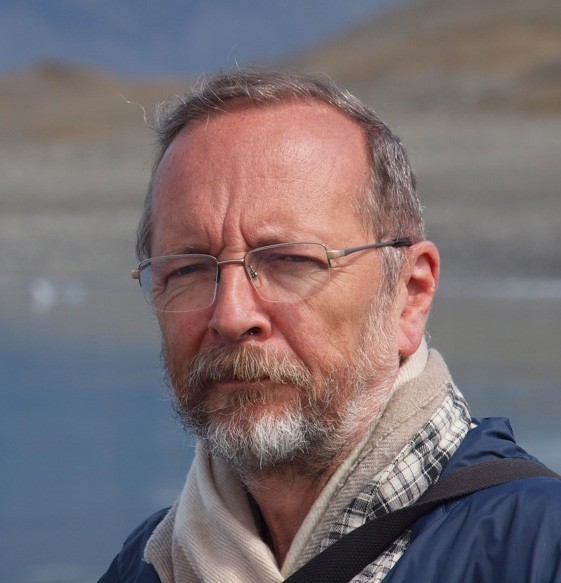
ONDŘEJ SLÁDEK: Jan Mukařovský and Roman Ingarden
The history of Czech structuralism is closely tied to the Prague Linguistic Circle (1926-1948; renewed 1990), which provided the basis for formulating key methodological principles and structural approaches to language, literature, and art. Although Czech structuralism has been the subject of extensive research, its relationship to phenomenology has received considerably less attention. Many scholars point to the influence of Roman Ingarden, particularly his Das literarische Kunstwerk (1931). A comparison of Ingarden’s phenomenology with Czech structuralist thought reveals both notable parallels and substantive differences.
Jan Mukařovský (1891-1975), a leading Czech literary scholar and aesthetician, maintained a close intellectual relationship with Ingarden. His engagement with phenomenology developed gradually through the selective adaptation of concepts drawn from Husserl and Ingarden. While these influences were significant, marked theoretical discrepancies eventually led him to observe that his fascination with Husserlian phenomenology had brought him “to the brink of self-denial.” Nonetheless, certain phenomenological notions – such as intention, intentional object, and aesthetic object – remained integral to his later work.
There are many still unanswered questions. For example: What do we know about the real relationships between Czech structuralists and Roman Ingarden? Can we find any specific and continuous contacts between them? What is specific for interconnection and cooperation between structuralism and phenomenology in the scholarly works of Jan Mukařovský and Roman Ingarden?
The aim of this study is to examine mutual reflections between Mukařovský and Ingarden and to identify the most influential and enduring elements of their structural-phenomenological conception of the literary work of art.
Ondřej Sládek is a senior researcher at the Institute of Czech Literature of the Czech Academy of Sciences, and a senior lecturer at the Faculty of Education, Masaryk University, Brno. He researches mainly in literary theory, narratology, semiotics and literary structuralism. He has published two monographs: The Metamorphoses of Prague School Structural Poetics (2015) and Jan Mukařovský. Život a dílo (Jan Mukařovský. Life and Works, 2015). He is also the editor and the co-editor of Český strukturalismus po poststrukturalismu (Czech Structuralism after Poststructuralism, 2006); O psaní dějin (On Writing History, 2007); Vyprávění v kontextu (Narrative in Context, 2008); Performance/performativita (Performance/performativity, 2010); Four Studies of Narrative (2010); Český strukturalismus v diskusi (Czech Structuralism in Discussion, 2014); etc. He is also the editor-in-chief of Slovník literárnědného strukturalismu (A Dictionary of Structuralist Literary Theory and Criticism, 2018).

PIERRE-YVES TESTENOIRE: L’Amérique au CLP et le CLP en Amérique
Une présentation répandue dans les manuels d’histoire de la linguistique veut que la phonologie moderne ait émergé de façon concomitante en deux endroits du globe dans les années trente : en Europe et en Amérique. Cette idée est présente dans les cours que Jakobson donne en arrivant aux États-Unis : le phonème aurait été fait l’objet d’une double « découverte » : au sein du Cercle linguistique de Prague et aux États-Unis, grâce à Sapir et Bloomfield (Jakobson 1976 [1942] : 56 sq.). Cette présentation fait fond sur l’imaginaire des correspondances cachées qui structure la pensée de Jakobson et, par conséquent, sa conception de l’histoire des sciences. Or, cette présentation, largement reprise par l’historiographie, occulte les échanges entre les membres du Cercle linguistique de Prague et les linguistes américains. C’est à l’analyse de ces échanges que sera consacrée notre contribution.
À partir de sources connues et d’archives inédites, on s’attachera aux contacts entre les membres du Cercle linguistique de Prague et les linguistes américains. Ces contacts vont de la correspondance (Hagège, 1967, Toman, 1994, Troubetzkoy 2006) à la participation des savants américains aux congrès européens, en passant par des controverses sur la phonologie (Twaddell 1935, Swadesh 1935, Trnka 1935, Vachek 1936). Le premier temps de la communication portera donc sur la place discrète, mais non négligeable, de l’Amérique dans les travaux du CLP. Le second temps explorera, en regard, les premières réceptions des travaux du CLP en Amérique avant-guerre, puis dans le sillage de l’arrivée de Jakobson aux États-Unis (Testenoire 2025).
Bibliographie :
- Eramian G. M., 1988, « Edward Sapir and the Prague School », Historiographia Linguistica, 15/3 : 377-399.
- Hagège C., 1967, « Extraits de la correspondance de N. S. Trubetzkoy », La Linguistique, 3/1 : 109-136.
- Jakobson R., 2014 [1935a], « Obecná linguistika v SSSR » [Linguistique générale en URSS], Selected Writings IX/2. Completion, The Hague, Mouton : 78-80.
- Jakobson R., 2014 [1935b], « Lingvistika » [Linguistique], Selected Writings IX/2. Completion, The Hague, Mouton : 96-101.
- Jakobson R. et al., 2014 [1935], « Association internationale pour les études phonologiques. Information bulletin n°2 », Selected Writings IX/2. Completion, The Hague, Mouton : 83-95.
- Jakobson R., 1976 [1942], Six leçons sur le son et le sens, Paris, Minuit.
- Newmeyer F. J., 2022, American Linguistics in Transition. From Post-Bloomfieldian Structuralism to Generative Grammar, Oxford, Oxford University Press.
- Swadesh M., 1935, « Twaddell on Defining the Phoneme », Language, 11/3 : 244-250.
- Testenoire P.-Y., 2025, Les cours de Roman Jakobson à l’École libre des hautes études, Berlin, De Gruyter.
- Toman J., 1994, Letters and Other Materials from the Moscow and Prague Linguistic Circles, 1912-1945, Ann Arbor, Michigan Slavic Publication.
- Toman J., 1995, The Magic of a Common Language. Jakobson, Mathesius, Trubetzkoy, and the Prague Linguistic Circle, Cambridge Mass. – London, The MIT Press.
- Trnka B., 1935, « O definici fonématu » [À propos de la définition du phonème], Slovo a slovesnost, 1 : 238-240.
- Troubetzkoy N. S., 2006, Correspondance avec Roman Jakobson et autres écrits, éd. et trad. P. Sériot, Lausanne, Payot.
- Twaddell W. F., 1935, On Defining the Phoneme, Baltimore, Language Monographs.
- Vachek J., 1936, « One Aspect of the Phoneme Theory », Proceedings of the Second International Congress of Phonetic Sciences, London, 22-26 July 1935, Cambridge, At the University Press : 33-40.
Pierre-Yves Testenoire est professeur des universités en linguistique et histoire des idées linguistiques à l’Université Sorbonne Nouvelle, et directeur adjoint du laboratoire Histoire des idées linguistiques (CNRS, UMR 7597). Ses recherches portent sur la réception de la pensée saussurienne, les théories de l’écriture et les liens entre linguistique et anthropologie au XXe siècle. Il est l’auteur de : Ferdinand de Saussure à la recherche des anagrammes (2013), Ferdinand de Saussure, Anagrammes homériques (2013), Les Anagrammes (2021) et Les Cours de Roman Jakobson à l’école libre des hautes études (2025).

JINDRICH TOMAN: Prague Phonology and Its Logicians: Karcevskij, Trubetzkoy, Jakobson
The presentation focuses on interwar research which aimed at the conception of phonological systems as logically structured. Among the members of the PLC it was especially Karcevskij, Trubetzkoy, and Jakobson who argued for phonological systems as layered, i.e., asymmetrically structured. This research culminated in Jakobson’s monograph Kindersprache, Aphasie und allgemeine Lautgesetze (1941), which in partial reference to Husserl used implicational relations (Fundierungsgesetze) to make layering (Schichtung) – and hence markedness – a central premise, eventually raising layering to an overarching perspective in the study of language and culture. Context, legacy, and potential weaknesses of this theory will be part of the presentation. Little known sources, including epistolary and archival documents, are used to substantiate the argument.
Jindřich Toman is a professor of Slavic Languages and Literatures and of Judaic studies at the University of Michigan, Ann Arbor. Trained in Czechoslovakia, Germany and USA, he has been following an academic path defined by languages and cultures of Central Europe. In the 1980s and 1990s he focused on linguistics, with special emphasis on Czech and German, as well as on the history of this discipline (The Magic of a Common Language: Mathesius, Jakobson, Trubetzkoy and the Prague Linguistic Circle, 1995). Later research has been situated at interfaces of cultural history and visual culture, with topics including modernist book design (Czech Cubism and the Book, 2004; Photomontage in Print, 2009). He also co-curated several exhibitions, including Jindřich Heisler: Surrealism Under Pressure (Art Institute of Chicago, 2012). His Judaic research is reflected by the monograph Bohemia’s Jews and their Nineteenth Century (2023).

ANNE-GAËLLE TOUTAIN: La référence martinettienne aux travaux de l’école de Prague. De l’histoire à l’épistémologie
Les liens d’André Martinet avec l’École de Prague sont bien connus et documentés (Pešek 2014), de même que les points communs et divergences entre les théories des deux protagonistes majeurs de l’École de Prague, Roman Jakobson et Nicolas Troubetzkoy, d’une part, et celle de Martinet, d’autre part (Verleyen 2009, Feuillard 2014, Toutain 2015). L’originalité de mon étude réside dans le déplacement de perspective qu’elle opère, de l’histoire à l’épistémologie de la linguistique. Aux quatre types d’histoires de la linguistique distingués par John Joseph (2024), j’en ajouterai un cinquième : l’histoire épistémologique, et m’efforcerai de faire paraître, sur l’exemple de la référence martinettienne aux travaux de l’école de Prague, la nécessité du concept bachelardien de rupture épistémologique.
Dans la conclusion de Structure et totalité, argumentant en faveur de la nécessité, en linguistique, de complexifier le modèle bachelardien, auquel il substitue son « modèle du balancier », Patrick Sériot écrit que « [l]’affirmation de Jakobson selon laquelle la nouvelle science doit avoir pour nom “structuralisme” doit s’entendre non pas à la façon de Saussure, mais à partir d’un autre cheminement, que nous pourrions appeler un structuralisme ontologique », et ajoute que, cependant, « [c]es deux conceptions si différentes de la structure, celle de Prague et celle de Genève, avaient suffisamment en commun pour être transformées en une synthèse féconde, par exemple chez A. Martinet » (Sériot 1999 : 312). Dans la lignée de mes différents travaux (notamment Toutain 2014, 2015), je montrerai pour ma part qu’aucune synthèse n’est possible entre les théories structuralistes praguoise et martinettienne d’une part, et la théorie saussurienne, d’autre part, qui relèvent de problématiques radicalement différentes. Nous verrons que c’est là, précisément, l’enjeu de la référence martinettienne à Prague, qui – et c’est une singularité de Martinet dans l’ensemble du structuralisme européen –, prime sur la référence à Saussure. Dans cette perspective, reconfiguration et rupture n’apparaissent pas incompatibles, mais relatives à deux problématiques différentes, que pourrait résumer l’opposition entre faire école (Puech 2015) et se mettre à l’école de.
Bibliographie :
- Joseph, J. E. (2024). « Presentist, Trajectorial and Heliocentric Approaches to Teaching the History of Linguistics. », in Proceedings of the Linguistic Society of America 9 (2), p. 1-7. https://doi.org/10.3765/plsa.v9i2.5745.
- Feuillard, C. (2014). « André Martinet et le Cercle linguistique de Prague – II. Principes théoriques et méthodologiques », in La linguistique 50, p. 35-74.
- Pešek, O. (2014). « André Martinet et le Cercle linguistique de Prague – I. Rapports personnels et interactions bibliographiques », in La linguistique 50, p. 7-33.
- Puech, C. (2015). « Présentation. La notion d’“école linguistique” : unité, singularité, pluralité », in Histoire Épistémologie Langage 37 (2) : « Faire école » en linguistique au XXe siècle : l’école de Genève, p. 5-15.
- Sériot, P. (1999). Structure et totalité. Les origines intellectuelles du structuralisme en Europe centrale et orientale. Paris : Puf.
- Toutain, A.-G. (2014). La rupture saussurienne. L’espace du langage. Louvain-la-Neuve : Academia-Bruylant.
- Toutain, A.-G. (2015). La problématique phonologique. Du structuralisme linguistique comme idéologie scientifique. Paris : Classiques Garnier.
- Verleyen, S. (2009). Fonction, forme et variation. Analyse métathéorique de trois modèles du changement phonique au XXe siècle (1929-1982). Louvain : Peeters.
Anne-Gaëlle Toutain is associate professor in linguistics at the Institute of French Language and Literature at the University of Bern (Switzerland). Her research focuses on the history and epistemology of language sciences and covers Saussurean linguistics, structuralism, neurolinguistics and the relationship between linguistics and psychoanalysis.
LIDIA TRIPICCIONE: Scholarship, Criticism and Theory: René Wellek between Czechoslovakia and the US
There is no dearth of scholarship on René Wellek’s interwar years in Czechoslovakia and on his contribution to American scholarship after he moved to the USA in 1939. His studies in Prague under Otokar Fischer and Vilém Mathesius and his participation in the Prague Linguistic Circle in the 1930s are well covered by Zelenka (1996) and Pospíšil (1996a and 1996b), whereas numerous publications have been devoted to his relationship with New Criticism and his role as founding father of comparative literature in the USA (Lawell 1988; Strelka 1984). However, these two periods in Wellek’s career are usually considered in isolation, so that with few exceptions (such as Sládek 2015 and the biographer Martin Bucco 1981), Wellek’s transition from Czechoslovakia to the United States has yet to be adequately investigated, much like his sojourn in the UK and the US in the mid-1920s.
My contribution will focus on four fundamental étapes in René Wellek’s scholarly career straddling his Czechoslovak and American periods: the article “The Theory of Literary History”, published in English in the 6th volume of the Travaux du Cercle linguistique de Prague, Wellek’s contribution to the volume Literary Scholarship. Its Aims and Methods (Wellek 1941), the publication – together with Austin Warren – of the much acclaimed Theory of Literature (1949), and, finally, the closing remarks that Wellek delivered at the “Conference on Style” held in Bloomington, Indiana, in 1958 (Wellek 1960). At the same conference, Jakobson also delivered his famous closing remarks on poetics and linguistics (Jakobson 1960).
This focus will allow me to map the continuity between Wellek’s conception of “perspectivism” and of literary scholarship as criticism that he first clearly laid out in 1936 in dialogue not only with members of the Prague Linguistic Circles like Roman Jakobson and Jan Mukařovsky, but also with the ideas of American critic Norman Foerster (1887-1972), author of The American Scholar (1929). When Wellek joined Foerster’s School of Letter at the State University of Iowa in Iowa City in 1939, his interest in scholarship as criticism found fertile ground and developed into the pedagogical and reformist plan espoused in Literary Scholarship (edited by Foerster) and in Theory of Literature in 1949. The presentation will discuss the import (intellectual as well as political) of Wellek and Warren’s innovative understanding of comparative literature for post-WWII American academia and will show how Wellek continued to defend his conception of literary scholarship against what he perceived as an undue encroachment on its disciplinary autonomy on the part of linguistics and other fields in the 1958 conference. Overall, my contribution will highlight how Wellek’s transition to the United States and the ensuing dialogue between a member of the Prague Linguistic Circle and American scholars and critics like Foerster and Warren resulted in a broad scholarly and pedagogical project defining the scope and significance of literary scholarship and theory and competing with other conceptions, like Roman Jakobson’s understanding of poetics.
Bibliography:
- Bucco, Martin. 1981. René Wellek. Boston: Twayne Publishers.
- Foerster, Norman. 1929. The American Scholar. A Study in Literature Inhumaniores. Chapel Hill: University of North Carolina Press.
- Jakobson, Roman. 1960. “Closing Statements. Linguistics and Poetics.” In Sebeok, Thomas (Ed.), Style in Language. Cambridge (MA): John Wiley and Sons, 350-377.
- Lawall, Sarah. 1988. “René Wellek and Modern Literary Criticism.” Comparative Literature, 40 (1): 3-24.
- Pospíšil, Ivo. 1996. “Na křižovatce: René Wellek a některé genetické a typologické souvislosti literární vědy 20. a 30. let.” In Pospíšil, Ivo, and Zelenka, Miloš (Eds.) René Wellek a meziválečné Československo (ke kořenům strukturální estetiky), 7-33. Brno: Masarykova univerzita.
- Sládek, Ondřej. 2015. The Metamorphoses of Prague School of Structural Poetics. Munich: LINCOM.
- Strelka, Joseph. 1984. Literary Theory and Criticism. Festschrift presented to Rene Wellek in Honor of his Eightieth Birthday. Frankfurt: Peter Lang.
- Wellek, René. 1936. “The Theory of Literary History.” Travaux du Cercle Linguistique de Prague (Études dédiées au quatrième congrès de linguistes), 6 (1936): 173-191.
- Wellek, René. 1941. “Literary History.” In Norman Foerster (Ed.) Literary Scholarship. Its Aims and Methods. Chapel Hill: The University of North Carolina Press.
- Wellek, René. 1960. “Style in Literature. Closing Statement.” In Sebeok, Thomas (Ed.), Style in Language. Cambridge (MA): John Wiley and Sons, 408-419.
- Wellek, René and Warren, Austin. 1949. A Theory of Literature. New York: Harcourt and Brace.
- Zelenka, Miloš. 1996a. “Na pomezí vědy a umění. Poznámky ke genezi a kořenům Wellkovy literárněvědné metody.” In Pospíšil, Ivo, and Zelenka, Miloš René Wellek a meziválečné Československo (ke kořenům strukturální estetiky), 34-53. Brno: Masarykova univerzita.
- Zelenka, Miloš. 1996b. “Wellkova teorie dějin literatury v kontextu české školy literární komparatistiky. Strukturální estetika a základy srovnávací metody.” In Pospíšil, Ivo, and Zelenka, Miloš René Wellek a meziválečné Československo (ke kořenům strukturální estetiky), 65-81. Brno: Masarykova univerzita.
Lidia Tripiccione is Assistant Professor of Slavic Languages and Literatures at Princeton University. Her research focuses primarily on Russian Formalism and its “afterlives”. Her book-length project, tentatively entitled Scholarly Cold Wars and Publishing Quagmires, reconstructs the channels and international networks that led to the rediscovery of Formalism in Western countries between the 1950s and 1960s. As an offshoot of this project, she is also interested in the institutional and intellectual development of Slavic Studies and Comparative Literature, especially in the United States after WWII, and in the role that scholars from Central and Eastern Europe played in shaping these fields. Parallel to this, she has also published and presented on philology and literary scholarship in the Soviet Union. Her work has appeared in English and Russian in journals like Slavic Review, Poetics Today, and Novoe literaturnoe obozrenie, as well as in collected volumes.

SERHIJ WAKULENKO: La présence ukrainienne au sein du Cercle Linguistique de Prague : les personnalités, les idées, les échos
Le Cercle linguistique de Prague est souvent décrit comme une initiative russo-tchèque, devenue possible grâce à l’affluence des émigrés de l’Est en Tchécoslovaquie dans les années 1920. Pourtant, quatre originaires de l’Ukraine (un état inexistant à l’époque) ont également participé à ses activités : Agenor Artymovyč (1879–1935), Vasyl’ Simovyč (1880–1944), Dmytro Čyževs’kyj (1894–1977), Petro Savyc’kyj (1895–1968). Bien que leur apport soit été relativement modeste en termes quantitatifs, in ne doit pas être sous-estimé. Il est à signaler surtout que les idées d’Artymovyč sur l’écriture vue à travers un prisme phonologique ont servi de source d’inspiration à Josef Vachek (1909–1996), tandis que Čyževs’kyj a contribué à l’élaboration de la notion de phonème en réfutant les approches psychologisantes pratiquées par Jan Niecisław Baudouin de Courtenay (1845–1928), son ancien maître à l’Université de Saint-Pétersbourg. L’effort de Čyževs’kyj visant à l’établissement du statut ontologique du phonème continue à mériter l’attention des spécialistes de ce domaine par l’exemplaire clarté de l’argumentation. Plus tard, dans la Bavière de l’après-guerre, Čyževs’kyj reprendra encore ce sujet pour faire connaître ses idées dans les milieux des émigrés ukrainiens. En Ukraine elle-même, c’est Simovyč, établi à Lviv depuis 1933, qui s’est mis à propager les doctrines du Cercle. Sous le régime soviétique, malgré la réception plutôt bienveillante des théories pragoises en général, les noms des membres ukrainiens du Cercle étaient un tabou, car il s’agissait de personnes censées être adversaires politiques. Ce n’est qu’après l’indépendance du pays en 1991 que leur legs intellectuel commence à être plus largement connu, mais la thématique liée à leurs aboutissements pragois reste toujours dans l’ombre pour la plus grande partie du monde savant.
Après avoir travaillé une trentaine d’années à l’Université Pédagogique Nationale H. S. Skovoroda à Kharkiv (Ukraine), Serhij Wakulenko, aujourd’hui en retraite, revêt actuellement la fonction de Président de la Société Historico-Philologique de Kharkiv. Pendant sa carrière, il a fait des recherches dans le domaine de l’histoire des sciences et de la philosophie du langage en Autriche, Pologne, France, Allemagne ainsi qu’au Portugal. Ses nombreuses publications ciblent surtout les idées sémiotiques formées au sein de la scolastique tardive et les divers paradigmes méthodologiques dans la linguistique des deux derniers siècles. Il est aussi spécialiste en l’histoire de la langue ukrainienne.

IRINA WUTSDORFF: On the Relations of Prague School Aesthetics with (German Language) Herbartian Formal Aesthetics
This contribution addresses the widely debated question of the links between Herbartian formal aesthetics, which were firmly established in Prague, and the subsequent developments of Prague structuralism. Mukařovský is well known to have referred to this line of theory in order to ground his own aesthetics in a “domestic” tradition, thereby rejecting the notion that Prague structuralism, not least given the overlap in personnel, was merely a continuation of Russian formalism. Ingo Stöckmann’s recent intensive reappraisal of the Herbartian theoretical tradition (editing an anthology of texts on formalist aesthetics in 2019 and publishing a comprehensive monograph on the theory and history of formalist aesthetics in 2022) provides an opportunity to revisit the interrelationship between formal aesthetics and the aesthetics of the Prague School.
This is because the conceptualisations initiated or inspired by Herbart, which regard form as a relation between elements, can be seen as leading to a functionalist understanding of form, structure and system, as later developed in Prague structuralism. This relational understanding of form is also partly linked to a processual understanding and, in this respect, pointing to Mukařovský’s consistently dynamic conception of structure in his aesthetics.
Such connections reveal Prague structuralism to be a phenomenon shaped by the history of entanglement that is so characteristic of Central Europe.
Irina Wutsdorff is professor of Slavic studies at the University of Münster. After studying in Berlin and Prague, she earned her doctorate at the University of Potsdam with a thesis on Czech avant-garde Poetism. As a junior professor at the University of Tübingen she habilitated with a thesis on the relationship between literature and philosophy in Russian culture. Her research interests include the interrelationship between German and Czech modernism(s) in Prague and the intertwined history of literary and cultural theories.
